
An eCommerce site is not just a website
An online store is often seen as a website where a customer finds a product, adds it to the basket and pays for the order. For the business, the bigger part starts after that. The order has to reach inventory, invoicing, delivery and customer communication. Someone needs to know whether the product is actually available, whether the price is correct, whether the payment has arrived, whether the invoice has been issued and how the customer can follow the order status.
If the online store is not connected to the rest of the operation, the connection is created through people, spreadsheets and manual checks. At the beginning this can be perfectly manageable. A few orders per day, a limited product range and simple delivery do not yet require a large solution. The problem appears when sales grow, the product range expands and the same information is needed by sales, inventory, accounting and customer service.
Why a standard eCommerce platform can become limiting as the business grows
A standard eCommerce platform can be a very good way to start selling online. The limits often become visible later. The online store, inventory management and accounting may each follow their own logic, and every new requirement adds another integration, export or manual step.
In this situation, small errors start to repeat. Orders are entered again, stock levels do not always match between the website and the warehouse, invoices need separate checks and matching payments takes time. If every new connection fixes one place but makes the whole setup harder to manage, the main issue is no longer the look of the store. The question is whether daily operations remain under control.
What makes Odoo eCommerce different?
The difference with Odoo eCommerce is not only that it can be used to create an online store. What matters more is what happens after the purchase. Odoo connects online sales with sales management, inventory, invoicing, customer information, CRM, POS, purchasing and reporting.
The company does not have to stitch every data movement together separately. Product information, price lists, stock levels, sales orders, invoices and the customer view can follow the same business logic. This does not mean that configuration, integrations or custom development are never needed. It does mean that the online store is not a separate island, but part of the company’s everyday operations.
From order to invoice: how the workflow moves in Odoo
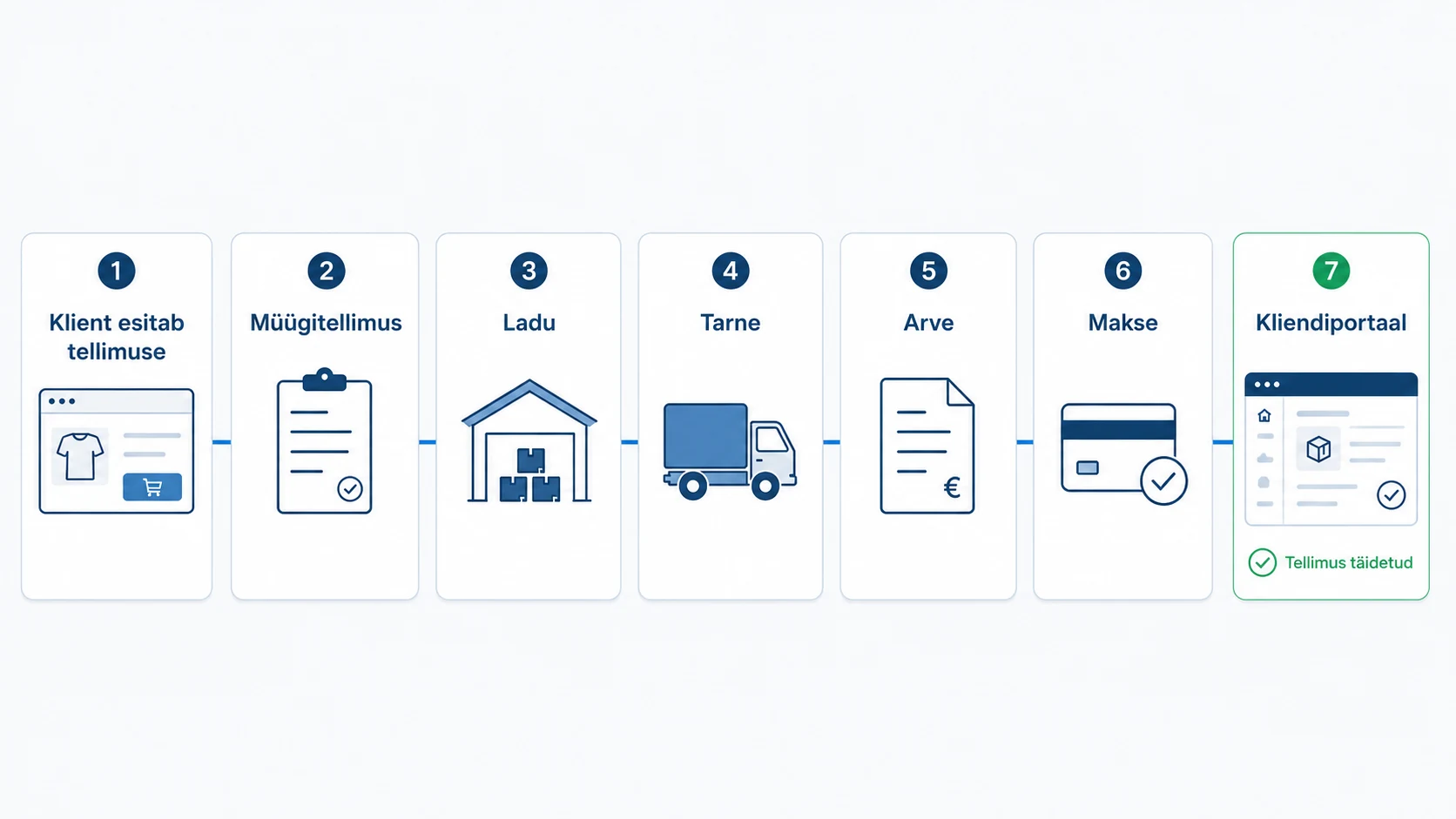
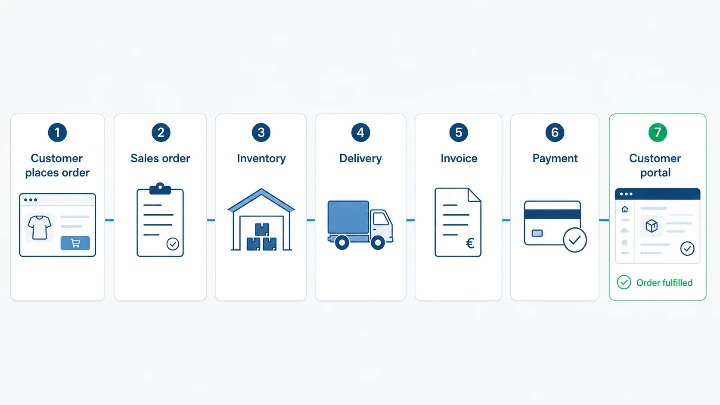
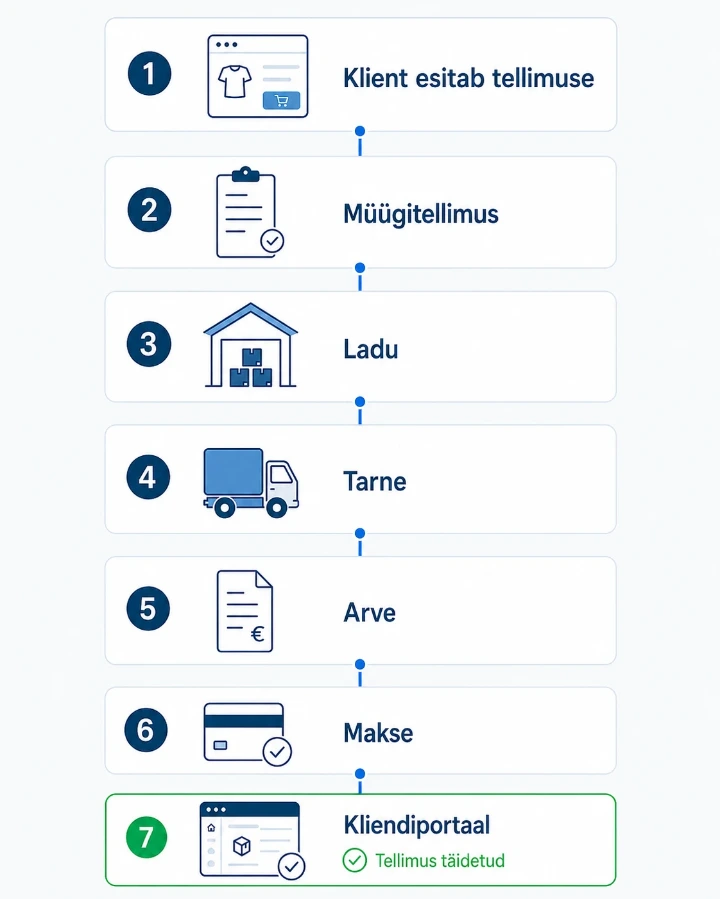
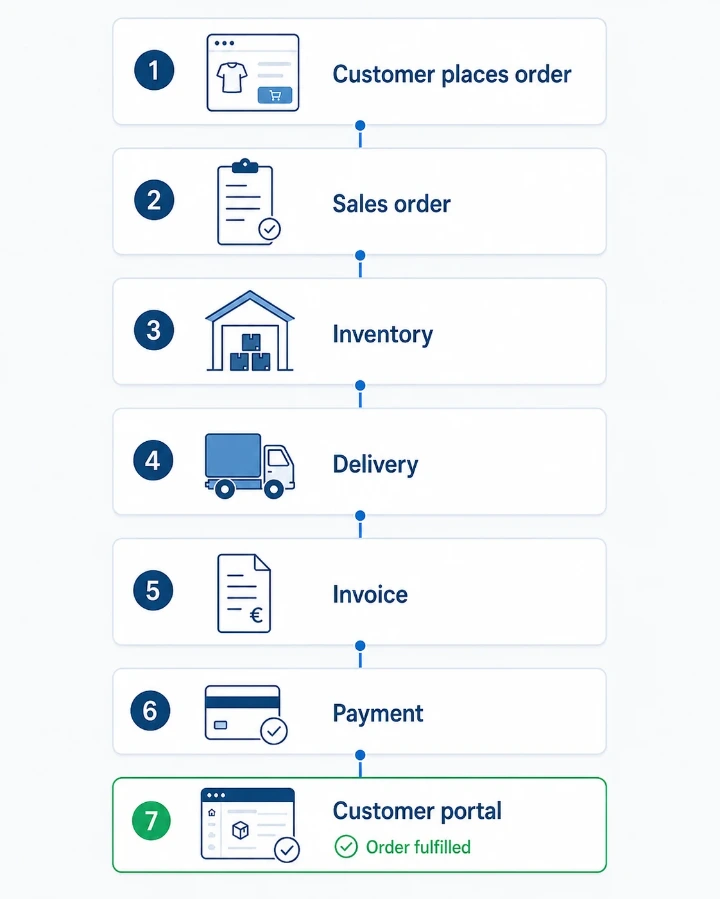
The practical value becomes clear in the way an order moves. A customer places an order in the online store. Odoo creates a sales order. The warehouse sees what needs to be picked. The goods are delivered. The invoice is issued. The payment is matched. The customer can access the order, invoice and other necessary information in the portal.
An order is not just a row in the eCommerce back office. It is a task for sales, inventory, invoicing and customer service. When information moves forward automatically, there is less need to ask a colleague, search for confirmations in emails or compare different export files manually.
Inventory and stock levels: why they are critical for eCommerce
Stock availability is a promise in an online store. If a customer sees that a product is available, they expect the company to be able to deliver it. That is why it is not enough for the product to look good on the website. The online store needs to know whether the product exists, where it is located and whether it has already been reserved for another order.
As the business grows, multiple warehouses, stock visibility, replenishment, deliveries and returns become more important. If a return only lands in the customer service inbox but does not reach the inventory and invoicing process, the whole operation remains incomplete. A good online store does not only display products; it helps control whether and from where they can actually be delivered.
B2B and B2C sales in one system
Not every online store works as a simple B2C basket. Many companies serve private customers, business customers, resellers, agreed prices, quotations and invoice payments at the same time. Odoo is a good fit when sales do not stop at one simple buying journey.
In B2B sales, customer-specific price lists, quotations, repeat orders, the customer portal and the sales representative’s role become important. For example, a business customer can see their own price list, orders and invoices in the portal, while the sales representative works from the same customer information.
Online and physical sales together
If the company also has physical sales, or may add them in the future, connecting the channels becomes important. A shared product catalogue, stock level and customer base help avoid a situation where the online store promises one thing, the till shows another and the sales team checks a third place.
With Odoo, online sales and POS sales can be treated as parts of the same business system. A customer can order online and collect the goods in store, make a repeat purchase on site or return a product at a physical sales point. In that case, eCommerce and POS are not two separate worlds, but two sales channels based on the same data and reporting.
Invoices, payments and accounting
As the online store grows, it also becomes important how an order becomes an invoice and how the payment is matched to that invoice. If the online store, payment solution and accounting are separate, data often needs to be checked, compared or matched manually.
Odoo helps build a process where the order, invoice, payment and reporting are better connected. Payment methods, local payment solutions, banks and accounting needs still have to be reviewed separately. A strong solution is not created simply because an invoice is generated. The value comes when invoicing and payment control fit the company’s real way of working.
Customisation: when the standard solution is not enough
Growing companies often encounter situations that a simple standard setup does not cover well. Some customer groups have their own prices, some orders need separate approval, delivery methods have to fit the local market and management needs reports that show more than online store sales alone.
One of Odoo’s strengths is that the standard solution can be extended through configuration, integrations or custom development where needed. This may mean special pricing, customer groups, specific order logic, local payment and delivery integrations, automated approvals or company-specific reports. Flexibility does not mean that every special request should immediately become a development task. First, it is necessary to understand which business rule actually matters.
When is Odoo eCommerce a good choice?
Odoo eCommerce is a good choice for a company where the online store is no longer a separate sales channel, but part of everyday management. It is especially relevant when order volume is growing, stock levels need to be accurate, sales happen across both B2B and B2C, or the company has several sales channels.
Odoo also becomes valuable when the goal is to reduce manual entry, connect the online store with invoicing or accounting and leave room for future processes. In that case, the company is no longer looking only for a new online store, but for a solution that helps keep sales, inventory, customers and invoicing better aligned.
When might Odoo not be the best choice?
Odoo is not always the simplest way to launch a small online store. If the goal is to open a simple campaign page quickly, sales volume is low and inventory and invoicing do not require separate management, a simpler eCommerce platform may be more sensible at first.
Implementing Odoo requires the company to think through how products, orders, customers, invoices and payments move. If the company is not ready to organise these processes, a larger system will not automatically create a better result. Odoo’s value becomes clearer when the online store needs to grow together with the company’s processes.
How to approach an Odoo eCommerce implementation
An Odoo eCommerce project does not have to start as the largest possible project. A sensible first step is to map how products, orders, stock levels, payments, deliveries and invoices move today. After that, product data and price lists can be cleaned up, the online store configured, the necessary payment and delivery methods connected and the full journey from order to invoice tested.
The first version does not need to use every possible feature at once. It is better to make the core process work first: product, order, inventory, payment, delivery and invoice. Once that works, the next layers can be added: automations, custom development, reports, customer portal options or new sales channels.
Conclusion: from online store to business system
Odoo eCommerce is more than an online store. It is a way to bring online sales, stock levels, invoices, payments and customer information into the same business logic. That is why Odoo is especially relevant for companies that want to grow eCommerce in a controlled way and avoid a situation where every business process moves separately.
Next step
Odoo eCommerce can be built on both Community and Enterprise editions. Community Edition is a free and open-source core that can be extended with suitable apps and integrations. Before choosing, it is important to check the specific Odoo version, required modules, Estonian localisation, payment and delivery integrations, and which parts need implementation or custom development.
Enterprise adds more ready-made capabilities and conveniences through a paid licence. From the perspective of the eCommerce setup, relevant areas may include more complete accounting functionality, the mobile app, document management, wider marketing tools, multi-company use and some additional inventory options. Enterprise is charged as a per-user monthly fee; exact prices and packages are available on Odoo’s official pricing page: odoo.com/pricing.
Want to know whether Odoo is a good fit for your online store? Start with an eCommerce workflow audit: we review sales, inventory, payments, deliveries, invoices and customer portal needs. Based on that, Esrap can help choose the right Odoo edition and hosting environment, define the first realistic stage and later support implementation, management, integrations and custom development.
Sources
- Odoo: eCommerce
- Odoo: Inventory
- Odoo: Invoicing
- Odoo: Editions Comparison